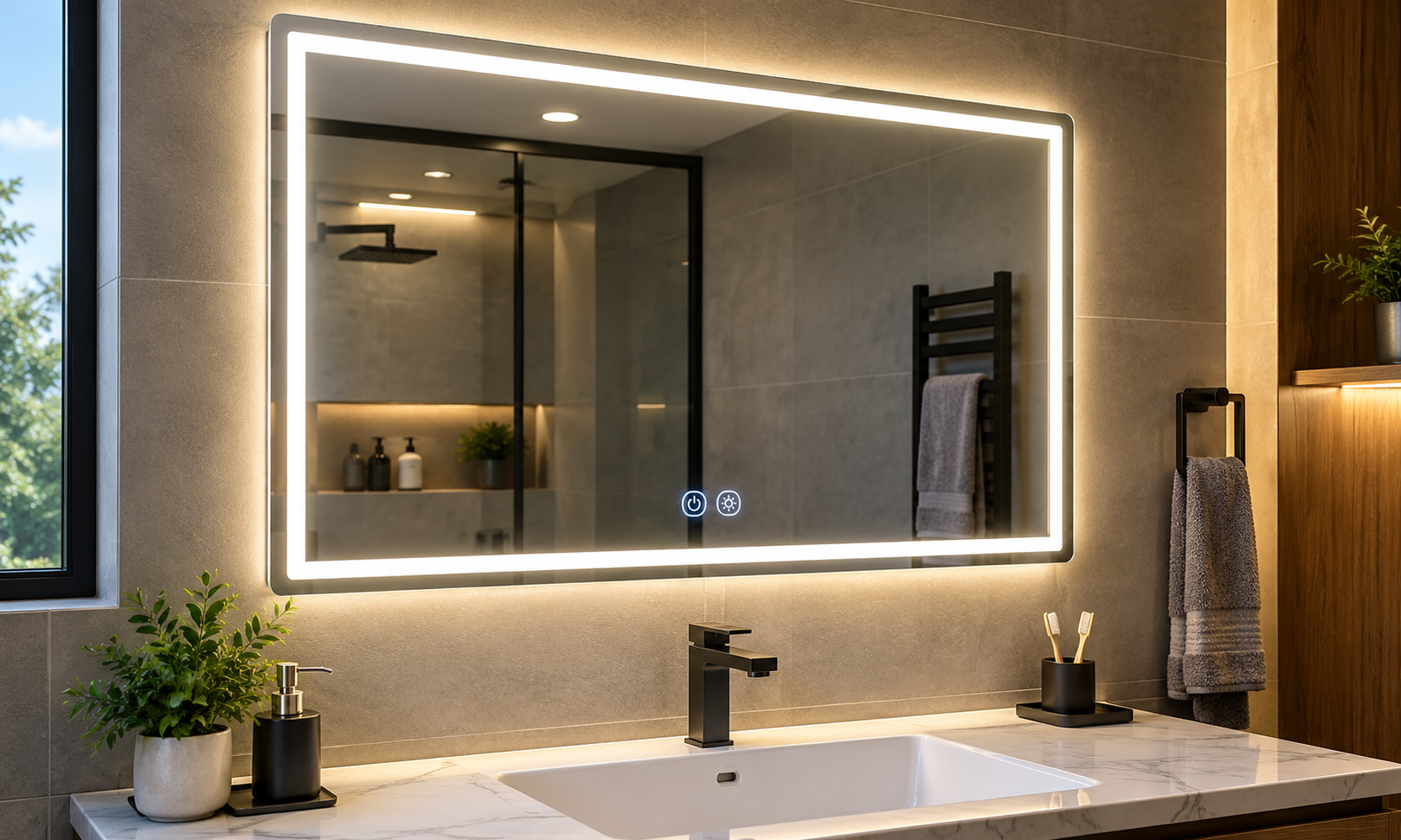

Large Bathroom Mirror Ideas That Make Small Bathrooms Look Bigger

wheel simulators
A small bathroom doesn't need a full renovation to feel bigger. One of the simplest and most effective design principles in interior design is that mirrors don't just reflect your face, they reflect light and sightlines. When a mirror is large enough, it tricks the eye into reading the room as deeper and more open than it actually is. Walls seem to dissolve, ceilings feel taller, and natural or artificial light gets bounced back into the space instead of being absorbed by tile and paint.
This is why designers consistently point to a large bathroom mirror as one of the highest return upgrades available for a tight footprint. It costs a fraction of what a remodel would, takes an afternoon rather than weeks, and delivers an immediate visual transformation the moment it goes up on the wall.
Why Mirror Size Matters More Than People Expect
Most homeowners default to a mirror that roughly matches the width of their sink, often somewhere around 24 to 30 inches. That habit comes from decades of standard vanity mirrors, not from what actually works best in a small room. A mirror that stops well short of the vanity edges creates a small, isolated reflective patch surrounded by wall, which does very little to change how the room feels.
A better approach is to think about the mirror as a second window rather than a grooming accessory. Here's how sizing generally breaks down:
- Full vanity width mirrors: Extending the mirror close to the outer edges of the countertop, rather than centering a smaller piece above the sink, creates the impression of an unbroken reflective wall. This is especially effective in single sink bathrooms where wall space is limited.
- Floor to ceiling installs: In powder rooms and half baths, a mirror that runs from just above the baseboard to near the ceiling line adds significant vertical volume to the room. Because powder rooms are often the smallest and most awkwardly shaped rooms in a home, this vertical stretch does a lot of visual heavy lifting.
- Large format versus multiple smaller mirrors: A single oversized mirror will almost always outperform two or three smaller mirrors grouped together. Multiple frames introduce visual breaks, seams, and shadow lines that subdivide the wall and remind the eye of the room's actual boundaries. One continuous reflective surface avoids that interruption entirely and reads as far more spacious.
Why an LED Bathroom Mirror Does More Than a Plain One
A plain glass mirror, no matter how large, is limited by the light already in the room. If the bathroom has a small window or a single overhead fixture, that's all the mirror has to work with. This is where a lighted bathroom mirror changes the equation.
An LED bathroom mirror generates its own light source directly at the reflective surface, and in a small room, that glow doesn't stay contained to the mirror itself. It bounces off tile, countertops, and adjacent walls, effectively raising the ambient brightness of the entire space rather than just illuminating your reflection. In a compact bathroom with low ceilings or no natural light, this compounding effect is often more noticeable than the size of the mirror alone.
A backlit mirror in particular tends to create a soft halo effect around its edges, which adds depth without adding visual weight. Because the light appears to emanate from behind the glass rather than from a separate fixture mounted above it, the wall looks less cluttered and the mirror itself seems to float, which reinforces the sense of open space. For anyone comparing a bathroom mirror with lights against a traditional wall sconce and mirror combination, the built in lighting almost always wins on both function and small bathroom design impact, since it eliminates the need for extra fixtures competing for wall real estate.
Mirror Shape and Size Pairings by Room Type
Not every small bathroom has the same proportions, so the right large mirror depends on the shape of the room itself. A few common scenarios and the pairings that tend to work best:
- Narrow powder room: A tall, arched mirror draws the eye upward and softens the boxy feel that narrow half baths often have. The rounded top also avoids sharp corners that can make a tight space feel more cramped.
- Shared double vanity: Rather than two separate mirrors over each sink, an oversized rectangular mirror with dual integrated lighting zones spans the full counter. This keeps the wall visually unified while still giving each person their own well lit area for grooming.
- Low ceiling bathroom: A wide oval mirror works better here than a tall rectangle, since it avoids adding more vertical bulk to a ceiling that already feels close. The horizontal emphasis stretches the wall sideways instead of drawing attention to how low the ceiling actually sits.
- Bathroom with a single small window: Position a large rectangular LED mirror on the wall facing or adjacent to the window so it can bounce whatever daylight is available, then supplement it with the mirror's own lighting for evening use.
- Awkward or angled wall bathroom: A round or soft edged oversized mirror tends to hide irregular wall angles better than a sharp cornered rectangle, since the curved frame doesn't emphasize misaligned lines the way a straight edge would.
Are Large Bathroom Mirrors Harder to Install?
This is one of the most common hesitations, and it's a fair question. Larger mirrors are heavier, and weight distribution matters more than it does with a small frameless mirror hung on a couple of clips.
That said, most large format mirrors, including LED and backlit models, are designed with this in mind. They typically come with reinforced mounting brackets, and manufacturers generally recommend anchoring into wall studs rather than relying on drywall anchors alone, especially for mirrors over a certain weight threshold. Some larger installs may also call for a French cleat style mounting system, which distributes weight evenly across a horizontal bar rather than a single point.
The safest approach is always to check the specific manufacturer's mounting guide before purchase, confirm the wall type you're working with, and, if there's any doubt about stud placement or wall material, bring in a professional installer. A large mirror is a long term fixture, so it's worth getting the mounting right the first time rather than troubleshooting later.
The Cost Per Square Inch Argument
When comparing prices, it's tempting to look at two smaller mirrors and assume they'll be cheaper than one large statement piece. In practice, the opposite is often true. Two separate mirrors typically mean two frames, two mounting systems, and in the case of LED models, two separate power connections and driver units. Each of those components adds cost independent of the actual glass size.
A single large format LED mirror, by comparison, spreads its fixed costs, frame, wiring, driver, anti fog pad if included, across a much bigger surface area. That generally makes the cost per square inch lower than buying multiples, while also delivering a cleaner installation with a single power connection instead of two. For anyone budgeting a small bathroom update, this makes an oversized mirror not just the better design choice but often the more efficient one financially as well.
Bringing It Together
A large, illuminated mirror is one of the few upgrades that changes how a small bathroom feels the moment it's installed, without touching plumbing, tile, or layout. Getting the size, shape, and lighting right for your specific room is what separates a mirror that simply hangs on the wall from one that actually makes the space feel bigger.
If you're ready to see how this looks in your own bathroom, LED Mirror World's collection of large LED bathroom mirrors is a practical place to start browsing shapes, sizes, and lighting styles built for exactly this kind of transformation.