
Debits and Credits Explained: The T-Account Method for Beginners

Trusted Translation Agency London UK
Learning debits and credits is often the moment where new bookkeepers and small business owners either fall in love with accounting or decide to hand it off to someone else entirely. The good news is that once the logic clicks, it rarely unclicks again. Debits and credits are not mysterious accounting jargon designed to confuse you. They are simply a way of keeping two sides of every transaction in balance, and once you understand the pattern behind them, you will start to see it everywhere in your financial records.
This guide breaks down debits and credits explained simply, walks through the T-account method step by step, and shows you exactly how common transactions like sales, purchases, and loans move through your books. By the end, you will have a clear mental model you can return to any time you second-guess yourself, along with a few memory tricks that make the rules stick.
What Double-Entry Bookkeeping Basics Actually Mean
Before diving into debits and credits themselves, it helps to understand the system they belong to: double-entry bookkeeping. This method has been the backbone of financial recordkeeping for centuries, and for good reason. It is built on one simple idea: every financial transaction affects at least two accounts, and those effects must always balance each other out.
Think about it this way. If your business buys a laptop with cash, two things happen at once. Your cash goes down, and your equipment goes up. Neither of these events happens in isolation. Double-entry bookkeeping basics require that both sides of this exchange get recorded, so your books always tell the full story rather than half of it.
This is different from single-entry bookkeeping, where you might just jot down "spent $1,200 on a laptop" in a ledger without tracking where that value went. Single-entry systems are simpler, but they cannot catch errors the way double-entry systems can. When you record both halves of a transaction correctly, your total debits will always equal your total credits. If they do not match, you know immediately that something needs a second look, long before it becomes a bigger problem at tax time or during an audit.
The accounting equation sits at the center of all of this:
Assets = Liabilities + Equity
Every transaction your business records has to keep this equation balanced. Debits and credits are the mechanism that makes this balancing act possible, and the T-account method is the visual tool that helps you see it happening in real time.
Debits and Credits Explained Simply
Here is where most beginners get tripped up, so let us clear it up right away. Debit does not mean "money coming in" and credit does not mean "money going out." That is a common assumption, especially because bank statements use those words differently than accountants do. In accounting, debit and credit are neutral terms that simply describe which side of an account an entry belongs on.
- A debit is an entry recorded on the left side of an account.
- A credit is an entry recorded on the right side of an account.
That is genuinely the whole definition. What debits and credits do to a specific account, whether they increase it or decrease it, depends entirely on what type of account you are looking at. This is the part that takes a little memorization at first, but it becomes second nature surprisingly quickly.
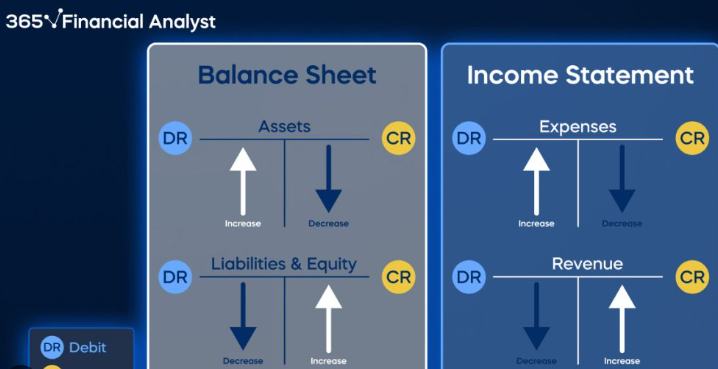
There are five main account categories in any chart of accounts, and each one has what is called a normal balance. The normal balance is simply the side where increases to that account are recorded.
- Assets: increase with a debit, decrease with a credit. Normal balance is a debit.
- Liabilities: increase with a credit, decrease with a debit. Normal balance is a credit.
- Equity: increase with a credit, decrease with a debit. Normal balance is a credit.
- Revenue: increase with a credit, decrease with a debit. Normal balance is a credit.
- Expenses: increase with a debit, decrease with a credit. Normal balance is a debit.
Notice the pattern. Assets and expenses behave the same way, growing with debits. Liabilities, equity, and revenue behave the same way, growing with credits. Once you memorize which group an account belongs to, you automatically know how debits and credits affect it.
The T-Account Method: A Visual Way to Track Every Transaction
The T-account method gets its name from its shape. Draw a horizontal line, then a vertical line hanging down from the middle, and you have something that looks like the letter T. The account name sits on top. Debits go on the left side of the vertical line, and credits go on the right side.
This simple visual does something powerful. It lets you separate increases from decreases so you never have to guess which direction a number is moving. Instead of trying to hold the whole transaction in your head, you can literally see both halves of it laid out.
Here is how to use a T-account in practice:
- Draw a T for each account involved in the transaction.
- Write the account name above the top line.
- Record the debit amount on the left side and the credit amount on the right side.
- Add up each side once you have recorded all the entries for a period.
- Subtract the smaller total from the larger total to find the account's ending balance.
If an asset account's debit side total is larger than its credit side total, the account carries a debit balance, which is exactly what you would expect since assets normally sit on the debit side. If a liability account's credit side is larger, that account carries a credit balance, again matching its normal balance.
The reason T-accounts have stuck around in accounting education for so long, even in an era of automated software, is that they force you to think through the logic of a transaction rather than just accepting whatever a system spits out. Understanding this method gives you the confidence to catch mistakes, whether you are reviewing your own books or reading a report from a bookkeeper.
T-Account Examples for Common Business Transactions
Reading about debits and credits only gets you so far. Seeing them applied to real situations is what makes the rules stick. Below are a few of the most common transactions a small business will encounter, broken down using the T-account method.
Example 1: Making a Cash Sale
Say your business sells a product for $500 cash. Two accounts are affected: Cash, which is an asset, and Sales Revenue, which is a revenue account.
- Cash increases, so it gets a debit of $500.
- Sales Revenue increases, so it gets a credit of $500.
In T-account form, you would write $500 on the left side of the Cash account and $500 on the right side of the Sales Revenue account. The transaction balances because one side received a debit and the other received a credit of equal value.
Example 2: Purchasing Supplies on Credit
Now imagine your business buys $300 worth of office supplies but does not pay cash right away. Instead, the supplier bills you, creating an Accounts Payable liability.
- Supplies, an asset, increases, so it gets a debit of $300.
- Accounts Payable, a liability, increases, so it gets a credit of $300.
Notice that no cash moved yet at all. The transaction still balances because you are tracking the increase in what you own alongside the increase in what you owe.
Example 3: Taking Out a Business Loan
Let us say your business takes out a $10,000 loan from a bank. This increases your cash and simultaneously increases a liability called Notes Payable or Loans Payable.
- Cash, an asset, increases, so it gets a debit of $10,000.
- Notes Payable, a liability, increases, so it gets a credit of $10,000.
This example often confuses beginners because it feels like the business just "gained" money. In reality, the business gained an asset (cash) but also took on an obligation (the loan), so both sides of the equation grow together and remain balanced.
Example 4: Paying Back Part of a Loan
When you make a loan payment, more than one account is usually involved, since a portion typically goes toward interest and a portion toward the principal balance.
- Notes Payable, a liability, decreases, so it gets a debit.
- Interest Expense, an expense, increases, so it gets a debit.
- Cash, an asset, decreases, so it gets a credit for the total payment amount.
This is a great example of how a single real-world event, one loan payment, can touch three separate T-accounts at once. As long as the total debits equal the total credits, the entry is correctly recorded.
Example 5: Owner Contributes Cash to the Business
If an owner puts personal money into the business, Cash increases and Owner's Equity increases as well.
- Cash, an asset, increases, so it gets a debit.
- Owner's Equity increases, so it gets a credit.
Memory Tricks for Beginners
Even with a solid grasp of the logic, it helps to have a few shortcuts on hand while the rules are still settling in.
- DEAD for accounts that increase with debits: Expenses, Assets, Dividends (or draws). If you can remember DEAD, you know these three account types grow on the debit side.
- CLIP or similar acronyms for accounts that increase with credits: Common stock or Capital, Liabilities, Income or revenue, Payables. Any variation works as long as it reminds you that these accounts grow on the credit side.
- Picture the T-account itself as a seesaw. Debits sit on the left, credits sit on the right, and for every transaction, the seesaw has to stay level. If one side moves, the other side has to move too, either on the same account or on a different one.
- Remember that debits and credits are directional, not judgmental. Neither one is inherently good or bad news for your business. A debit to an expense account and a debit to a cash account mean very different things for your financial health, even though they are technically the same type of entry.
- Whenever you are unsure, ask yourself two questions: What type of account is this, and is the value increasing or decreasing? Answer both, and the correct side falls into place automatically.
Why the Normal Balance Concept Matters
Understanding normal balance accounting rules is what turns memorized definitions into practical skill. When you know that assets and expenses normally carry debit balances, and liabilities, equity, and revenue normally carry credit balances, you gain a built-in error check. If your Accounts Payable account suddenly shows a debit balance for no clear reason, that is a signal to investigate, since liabilities are not supposed to sit on that side under normal circumstances.
This is also why trial balances work as a verification tool. A trial balance simply lists every account along with its balance, and totals the debit column against the credit column. If those two totals match, it is a strong sign that your entries have been recorded correctly, though it will not catch every possible mistake, such as a transaction posted to the wrong account entirely. Still, it is one of the fastest ways to spot an error before it works its way into your financial statements.
Bringing It All Together
Debits and credits can feel abstract the first few times you encounter them, but the T-account method turns an abstract rule into something visual and concrete. Once you can picture that simple T shape and remember which account types grow on which side, most everyday transactions become straightforward to record and review.
The key habits to build are these: identify which accounts a transaction touches, determine whether each account is increasing or decreasing, and apply the normal balance rules to decide which side gets the debit and which gets the credit. Practice this consistently with real transactions from your own business, whether that is a sale, a supply purchase, or a loan repayment, and the process will start to feel far more intuitive.
If you want a quick reference while you get comfortable with the rules, GlassJar's debits and credits cheat sheet is designed exactly for this purpose. It lays out normal balances, increase and decrease rules, and quick examples in one printable page, so you always have something to check against while your books are still fresh in your mind. Keeping that kind of reference nearby, especially in the early months of managing your own records, can save you from small errors that would otherwise be tedious to track down later.
Mastering debits and credits is less about memorizing a rulebook and more about building an instinct for how money moves through a business. With consistent practice using the T-account method, that instinct develops faster than most beginners expect, and it becomes one of the most useful financial skills you can carry into any part of running a business.